Calculating laboratory oven capacity helps you process daily sample loads efficiently, maintain consistent drying conditions, and avoid unnecessary delays. If you choose an oven that is too small, you may need multiple cycles to finish routine work. An oversized unit can consume more laboratory space and energy than your workload requires. By evaluating your sample dimensions, daily throughput, available shelf space, and operating schedule, you can determine the capacity that best fits your laboratory’s needs.
Calculate Your Daily Sample Volume
Start by identifying how many samples you need to process during a typical working day. Review your laboratory’s workload over several days to account for routine demand and occasional peaks.
Record the following information:
- Number of samples processed per day
- Dimensions of each sample or sample container
- Number of trays, racks, or containers required
- Drying time for each batch
- Loading, unloading, and cooling time between cycles
For example, if you process 48 samples daily and can safely accommodate 12 samples per batch, you will need four batches per day.
Formula:
Daily batches required = Total daily samples ÷ Samples per batch
Using this formula gives you an initial estimate of the oven capacity you need. However, you must also consider the available operating hours and the time required to complete each cycle.
Determine the Required Usable Chamber Volume
An oven’s advertised chamber volume does not always represent the space you can use effectively. Shelves, sample racks, airflow clearances, and container dimensions affect the actual loading capacity.
Calculate the volume of each sample container using its internal loading dimensions:
Container volume = Length × Width × Height
Multiply the result by the number of containers you expect to load simultaneously. Convert all measurements to consistent units before calculating.
For example, a tray measuring 30 cm long, 20 cm wide, and 5 cm high has a geometric volume of 3,000 cubic centimeters, or 3 liters. If you load 12 trays, their combined geometric volume is 36 liters.
This figure is only a preliminary estimate. You should not assume that a 36-liter chamber can accommodate those trays properly. You must also account for shelf spacing, tray arrangement, sample height, and the clearances required for uniform airflow.
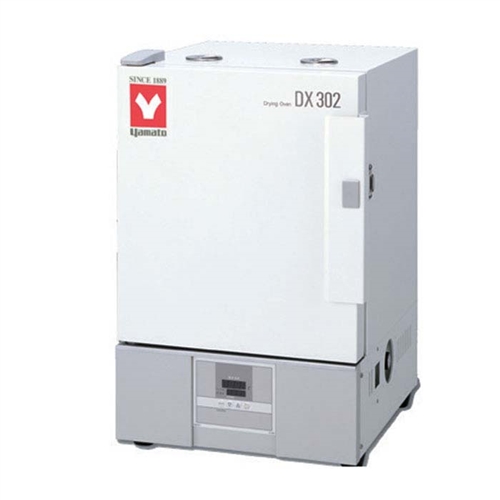
When comparing laboratory ovens for different sample sizes and daily processing requirements, evaluate usable shelf dimensions and loading arrangements rather than relying on chamber volume alone.
Calculate How Many Batches You Can Process Daily
Your oven must accommodate both the physical sample load and your daily production schedule. Calculate the complete cycle time, including heating, processing, cooling, and handling.
Use this formula:
Daily operating capacity = Available operating hours ÷ Total hours per cycle
Suppose your laboratory operates the oven for eight hours per day. Each complete cycle takes two hours, including loading and unloading.
Eight hours ÷ Two hours per cycle = Four cycles per day.
If each cycle accommodates 12 samples, your theoretical daily capacity is 48 samples.
In practice, equipment warm-up, temperature recovery after loading, cleaning, and unexpected delays may reduce throughput. If your daily demand is consistently close to the theoretical limit, consider a larger usable chamber, a shorter validated cycle, or an additional oven.
Never shorten a required drying or heating cycle simply to increase output. Your process requirements and sample integrity must remain the priority.
Account for Shelf Space and Airflow
A chamber may appear large enough on paper but still be unsuitable for your sample arrangement. Overloading shelves can obstruct circulation and create temperature variations that affect drying results.
Check these factors before finalizing your capacity calculation:
Shelf dimensions: Confirm that your trays fit without overhanging or blocking circulation.
Vertical clearance: Leave adequate space between shelves and samples.
Air circulation: Follow the manufacturer’s loading guidance to maintain uniform airflow.
Weight limits: Verify the maximum permitted load per shelf and for the entire chamber.
Sample compatibility: Confirm that the oven’s temperature range and materials suit your samples and containers.
For moisture-sensitive materials or applications requiring repeatable results, test your proposed loading arrangement under representative operating conditions. Temperature mapping or other appropriate validation may be necessary for critical processes.
Add a Practical Capacity Margin
Daily sample volumes rarely remain constant. You may receive additional samples, experience seasonal demand, or need to repeat a cycle when results fall outside your acceptance criteria.
Estimate your expected peak workload instead of sizing your oven solely around an average day. A practical approach is to compare normal demand with your highest anticipated daily load and select equipment that can handle the difference without compromising the process.
For example, if you normally process 48 samples but occasionally need to process 60, evaluate whether the oven can accommodate 15 samples per batch across four cycles, provided the sample arrangement and process conditions permit it. Otherwise, consider additional cycles or separate equipment.
A capacity margin should support realistic demand, not encourage overloading. Keep your decision grounded in usable space, validated cycle times, and the manufacturer’s operating limits.
Choose an Oven That Matches Your Workflow
Once you calculate the required sample volume, batch size, and daily throughput, compare suitable equipment specifications. Consider temperature uniformity, temperature range, controls, shelf configuration, recovery time, and energy requirements alongside chamber dimensions.
Review the available equipment from Global Lab Supply for laboratory ovens suited to routine drying and heating applications. Match the oven’s intended application to your laboratory’s actual requirements, whether you process small analytical samples, larger containers, or multiple trays in each cycle.
Before purchasing, document your calculations and confirm that the proposed oven can meet both normal and peak demand. If you need help matching chamber dimensions and operating specifications to your sample load, contact our team for laboratory oven selection assistance.
Frequently Asked Questions
1. How do you calculate the capacity of a laboratory oven?
Start by calculating the usable chamber and shelf space, then determine how many samples fit per batch. Consider sample dimensions, airflow clearances, shelf load limits, and the time needed to complete each cycle.
2. Is a larger laboratory oven always better?
No. A larger oven may provide more flexibility, but it can require additional space and energy. Choose a chamber that accommodates your typical and peak workload while maintaining appropriate heating conditions.
3. How many samples can a laboratory oven hold?
The number depends on sample dimensions, tray configuration, shelf spacing, weight limits, and airflow requirements. Calculate the usable loading area and verify your arrangement against the manufacturer’s instructions.
4. How does cycle time affect daily oven capacity?
Longer heating, drying, cooling, and handling times reduce the number of batches you can complete in a day. Calculate total cycle time rather than considering heating time alone.
5. What should you check before purchasing a laboratory oven?
Check usable chamber dimensions, temperature range, temperature uniformity, shelf capacity, controls, airflow, recovery time, and compatibility with your samples. Confirm that the oven can support your daily throughput without overloading.
Conclusion
Calculating laboratory oven capacity requires more than matching a chamber’s advertised volume to your sample quantity. You need to evaluate usable space, batch size, cycle time, airflow, weight limits, and peak daily demand together. With these factors documented, you can choose an oven that supports reliable processing, efficient scheduling, and consistent laboratory results.