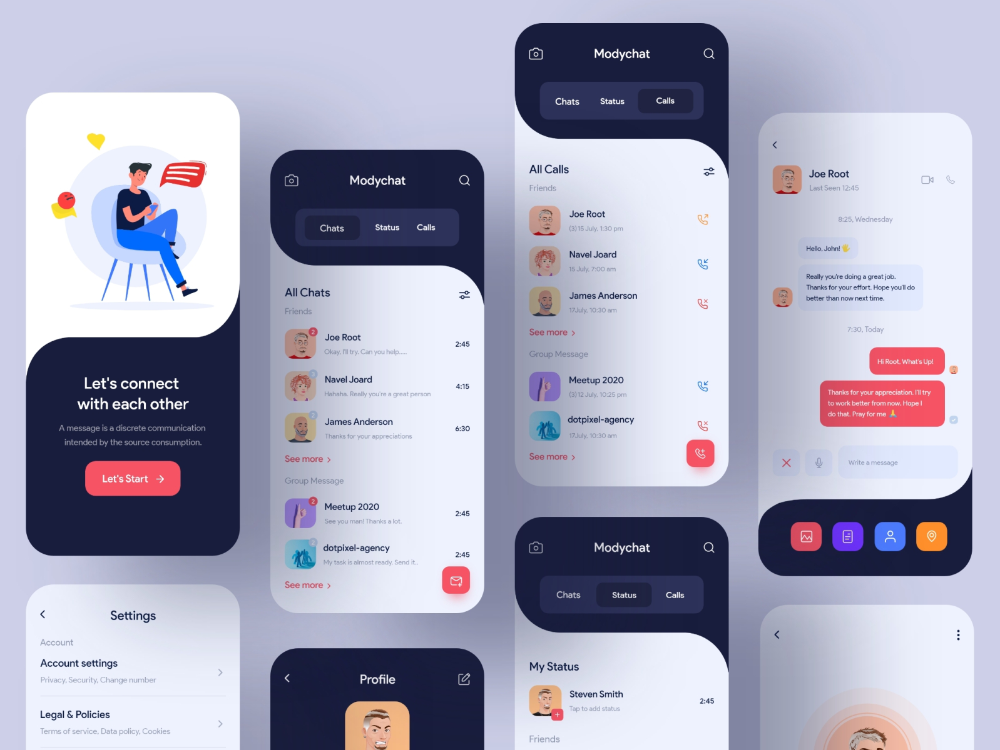
Design has a huge role to play in our everyday life, to access things easily. Be it designing a bottle, windows, doors, mobile phones, or an application. A good and simple design is all it takes to get the right audience and sustain your business in the market.
Take examples of companies like Apple, Netflix, Spotify, Google, or any other company whose design made it easy for you to interact with their product. UX helps companies to increase their customer retention rate and overall ROI. Every year there is something new coming in the field of UI/UX which makes it easy for your users to interact with your software. Additionally, you can hire mobile app developer and provide your users with a more personalized experience. Let’s see some of the leading mobile UI trends in the coming years.
Latest Mobile UI Trends:
Illustrations:
2D, 3D, custom illustrations, unaligned elements, components, and asymmetry helps companies to stand out from generic designs and create friendly and inviting environments. Illustrations help to make your entire website/mobile application stand out from the crowd and brings it to life with complex motion graphics. This makes it easy to capture users’ attention and explain your brand or company to them at a glance. Moreover, illustrations give your website or mobile apps more personality and make them memorable.
Moving elements and unexpected animations make users curious, inviting them to scroll further and see the entire interface. Additionally, whenever a change is made, your team should test it and also take conversion rate into consideration.
Custom Cursor Interaction:
Every company wants to stand out from the crowd in some way or another. Recently websites are implementing micro animations and flashy interactions. One of the trendiest interactions is when the movement of users’ cursor is an input, creating lively and fun results. Technology provides more possibilities than before as our devices and their software improve every year. Product designers and engineers have more tools and there are brands that can play with the tiniest details.
Explore Metaverse:
Metaverse is the buzzword currently, all thanks to big investments and contributions companies are doing to make it better. With this rapid growth comes growth in the field of design. UI/UX designers need to keep up with the changing rules and make interactive and great designs for AR/VR applications. To design for AR/VR, designers will need to think out of the box, brush up on their design skills, and create designs that emphasize interactions that feel like it takes place in real-time.
Apple and Google already provide developers and designers with AR development platforms like ARCore and ARKit. It mixes the physical and virtual worlds.
3D:
3D design sounds complex and is also difficult to understand and implement as there are many complexities involved. It is difficult to implement them as there is a wide range of devices used by users with each having different configurations. This makes it difficult to render 3D designed elements on different platforms and also decreases the loading speed of applications or websites.
However, with recent growth in hardware and software, you can easily render 3D UI on different devices. In the coming years, animated elements like logos, illustrations, texts will be leading and help users to be interactive. Mostly, 3D UI is useful in the eCommerce market, as it provides users with in-depth insight into particular products.
Use Bolder Fonts:
Fonts speak a lot about your company. In the coming years, brands are likely to own and accept the aesthetics of bolder fonts in their UI. Typography has a huge role to play when it comes to brand recognition and helping companies stand out from the competition and connect with audiences. A good write-up with bold fonts helps you to capture your users’ attention. So, don’t stop yourself from making the bold decision of using bold fonts.
Low Code or No-Code Platforms:
There are platforms that do not require code or use low code. There are websites like Webflow, SquareSpace, etc., with which designers can easily develop their websites. Designers can simply drag and drop needed features and elements in the system and provide customers with the best possible solution. Rather than seeing the same template used on several websites, it enables users to build unique and creative pages. UX/UI designers need to work with creativity and innovation.
Dynamic Color Palettes:
With Android 12, Google launched the all-new user interface i.e. Material You. It boasts dynamic colour palettes, which gives users freedom for more customization. Based on your phone’s wallpaper, it suggests a palette that can cohesively work for the font, icon colour, and accent color. Now, when UI/UX designers are designing an application for Android 12, they will have to make sure that their application is supporting the latest updates of Android 12.
System-like UI:
Google recently launched the all-new Material Design user interface components for their iOS apps. So, now instead of building custom code, investing in the long term, UX helps apps to feel better on Apple platforms. As a designer, you will need to take care of the fact that businesses can make necessary changes when and where needed.
Well, that’s not all where trends end. Below are 2 extra trends you can expect in mobile app UI trends:
Story-telling:
It is important to tell great stories about a digital experience as it will help your brand to trend and connect to the user. Typography is the first level of strong visual hierarchy and is an extremely important element of UI to provide a great user experience. Once the text style and fonts are defined, the second most important aspect is copywriting i.e. narrative as it engages users with the brand because it makes them feel like they are part of a story. Thus, focus more on storytelling and connect with your audience at a personal level.
Design for Foldable Phones:
Foldable phones are currently trending in the market all thanks to the latest buzz of Samsung’s foldable phones. Even other manufacturers like Google, Xiaomi, etc., are trying their hands in the market. With the increasing demand for foldable phones, it is also important for OS and applications to support emerging technology like foldable phones. The market of designing for foldable phones is slowly emerging and once again UX designers will have to upscale themselves and generate better designs.
Conclusion:
UI/UX has started playing a major role in the industry and companies have started understanding the importance of it. Today, designers work for dedicated mobile and application designs which in turn helps businesses to increase their ROI and retain customers. With the recent trends coming up, developers will have to upscale themselves and build and create great overall designs. If you are planning to develop an application with great UI, hire a mobile app developer and bring your ideas to life.